
An evidence-based analysis of military escalation risk, expert-projected casualty figures from CSIS and RAND war game simulations, and what a Taiwan Strait conflict would mean for the world. Updated regularly as the situation develops.
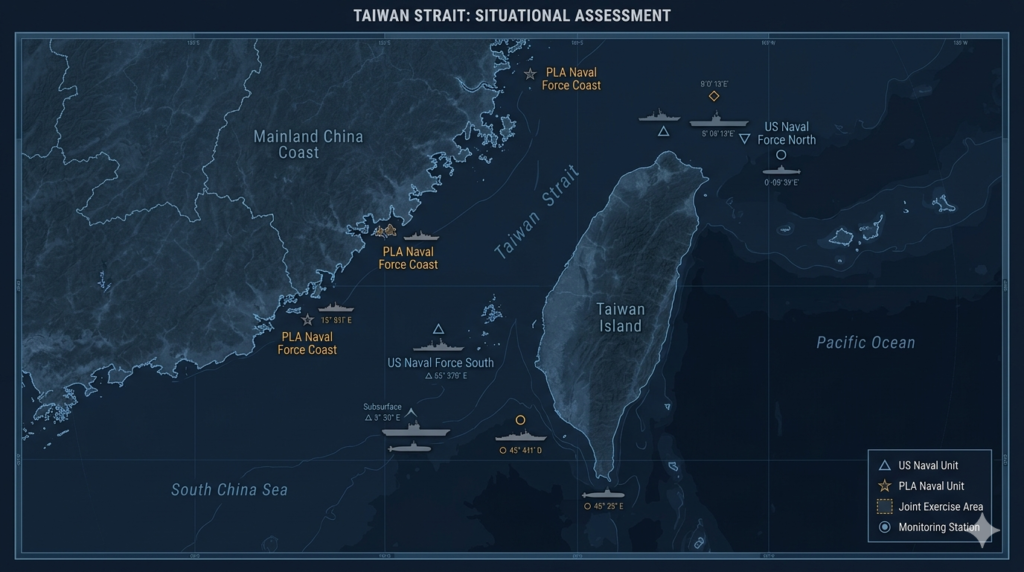
The Question Millions Are Asking in 2026
A plain-language breakdown of who, what, why, and what it would cost the world
The Taiwan Strait has been one of the world’s most closely watched flashpoints for over 70 years — ever since the Chinese Communist Party under Mao Zedong drove Chiang Kai-shek’s Republic of China government to the island of Taiwan in 1949. Since then, Beijing has maintained that Taiwan is a breakaway province that will eventually be “reunified” with mainland China — by force if necessary. Taiwan, meanwhile, has built one of Asia’s most prosperous democracies and a world-leading semiconductor industry, and the vast majority of its population supports keeping the status quo.
In 2026, with the global conflict environment already at its most intense since World War II — the Iran-Israel-US conflict, Ukraine, Gaza, Sudan — search volume for “China Taiwan war” has surged over 1,400%. People want to know: Is it actually going to happen? What would it look like? How many would die?
This article compiles the best available expert data — from the Center for Strategic and International Studies (CSIS), RAND Corporation, the US Congressional Research Service, and the Pentagon’s own assessments — to give you a research-grade answer. No sensationalism. No speculation. Just the data.
Why 2026 Is the Year Analysts Are Watching Most Closely
Military analysts have long discussed Taiwan as a potential flashpoint, but 2026 has a distinct set of converging factors that make it more serious than prior years. Here is what the intelligence community, think tanks, and academic strategists have flagged:
1. China’s Military Modernization Is Near Complete
The People’s Liberation Army (PLA) launched an aggressive 30-year modernization programme following the 1996 Taiwan Strait Crisis, when US carrier groups successfully deterred Chinese pressure. The PLA set a target of being able to “fight and win wars” by 2035. Analysts at the RAND Corporation noted that the military balance across the Taiwan Strait has shifted significantly toward China over the past decade. Anti-ship missile systems, stealth aircraft, and the world’s largest navy by hull count now mean that a US intervention would face far steeper costs than at any prior point.
2. Xi Jinping’s Stated Timeline
At the 20th Party Congress in 2022, Xi Jinping explicitly stated that China “will never promise to renounce the use of force” over Taiwan and called reunification a “historic mission.” Multiple US military commanders — including the former head of US Indo-Pacific Command, Admiral Philip Davidson — have stated their belief that China could move on Taiwan before 2027. That window covers 2025–2027.
3. The Global Distraction Factor
With the United States currently engaged in the Iran-Israel conflict, active support for Ukraine, and management of multiple other crises simultaneously, Beijing is watching carefully to assess US resolve and military bandwidth. Several analysts from the Brookings Institution and CSIS have flagged that simultaneous multi-theatre demands on US military resources present a window of opportunity that Chinese military planners may be evaluating.
4. Taiwan’s Semiconductor Significance
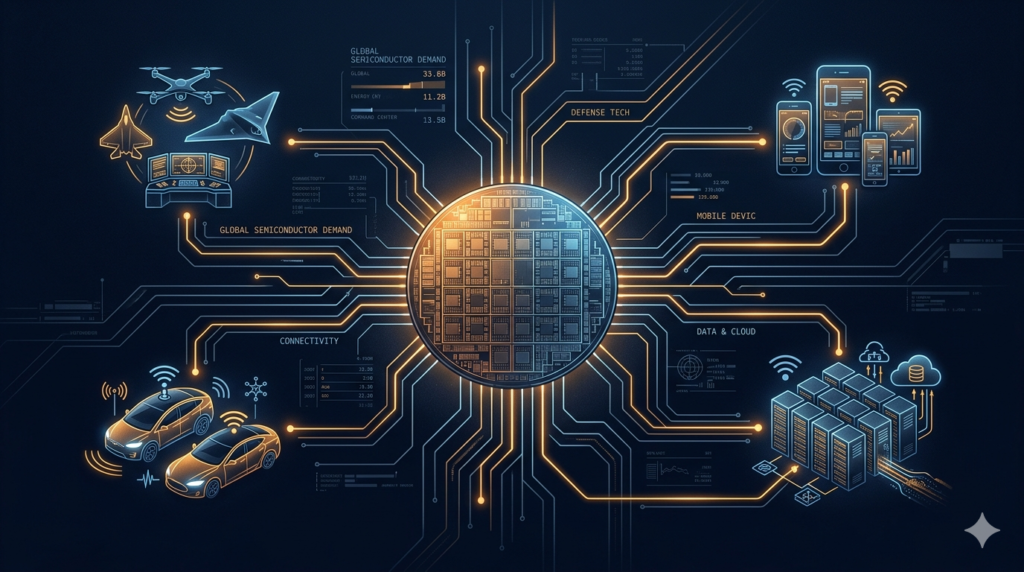
Taiwan Semiconductor Manufacturing Company (TSMC) produces approximately 90% of the world’s most advanced microchips. Every modern weapons system, smartphone, car, and data centre depends on chips Taiwan makes. A disruption to TSMC — whether through war, blockade, or sanctions — would be the single largest economic shock in modern history, estimated by the Munich Security Conference at $2 trillion in lost global GDP in the first year alone.
What the Numbers Would Look Like: Expert Projections
All figures below are projections from published academic and government war game studies. No conflict is currently active.
| Force / Party | Category | Low Estimate | High Estimate | CSIS Baseline | Source |
|---|---|---|---|---|---|
| 🇺🇸 United States Military | Killed in action | ~3,200 | ~10,000+ | ~3,200 | CSIS 2023 |
| 🇺🇸 United States Military | Aircraft Lost | 168 | 450+ | 168 | CSIS 2023 |
| 🇺🇸 United States Military | Naval Vessels Lost | 2 carriers | 5+ carriers | 2 carriers, ~15 ships | CSIS 2023 |
| 🇨🇳 People’s Liberation Army | Killed in action | ~10,000 | ~48,000 | ~10,000+ | CSIS 2023 |
| 🇨🇳 People’s Liberation Army | Troops Stranded | — | 30,000–40,000 | ~30,000 | CSIS 2023 |
| 🇨🇳 People’s Liberation Army | Aircraft Lost | 155 | 800+ | 155+ | CSIS 2023 |
| 🇨🇳 People’s Liberation Army | Naval Vessels Lost | 138 | 200+ | 138+ | CSIS 2023 |
| 🇹🇼 Taiwan Military | Killed in action | ~3,500 | ~15,000 | ~3,500 | CSIS 2023 |
| 🇯🇵 Japan (if involved) | Potential casualties | ~1,000 | ~10,000 | Variable | RAND 2021 |
| Combined Military Deaths (CSIS Baseline) | ~17,000+ | 3-week simulation window | |||
| Scenario | Civilian Deaths | Displaced | Infrastructure | Notes |
|---|---|---|---|---|
| Naval Blockade Only | Low (hundreds) | Minimal | Functional | Protracted economic pressure campaign |
| Air / Missile Campaign | ~10,000–50,000 | 1–3 million | Severely degraded | Depends on proximity of military targets to cities |
| Amphibious Invasion (Baseline) | ~50,000–200,000 | 5–10 million | Catastrophic | CSIS baseline — Taiwan pop: 23.5M |
| Prolonged Urban Warfare | 100,000–1M+ | 10 million+ | Total collapse | Ukraine-model projected onto Taiwan’s geography |
| Nuclear Escalation (worst case) | Millions | Tens of millions | Irreversible | RAND “termination risk” — very low probability |
| Most likely scenario (CSIS consensus) | 50,000–200,000 | 3–10M displaced | Per 3-week amphibious assault model | |
A critical finding from the CSIS study: in nearly every scenario, China fails to conquer Taiwan within the simulation window — but at catastrophic cost to all parties. The study’s authors note that a “pyrrhic victory” or a failed invasion both leave the world in a deeply destabilized state. The human cost — regardless of who “wins” militarily — is enormous.
Taiwan Strait Tensions: Year-by-Year Breakdown (2020–2026)
Tracking the concrete military, political, and diplomatic events that brought the Taiwan Strait to its current elevated tension level
How a Taiwan Conflict Would Compare Historically
Contextualizing expert projections against verified historical conflict casualties
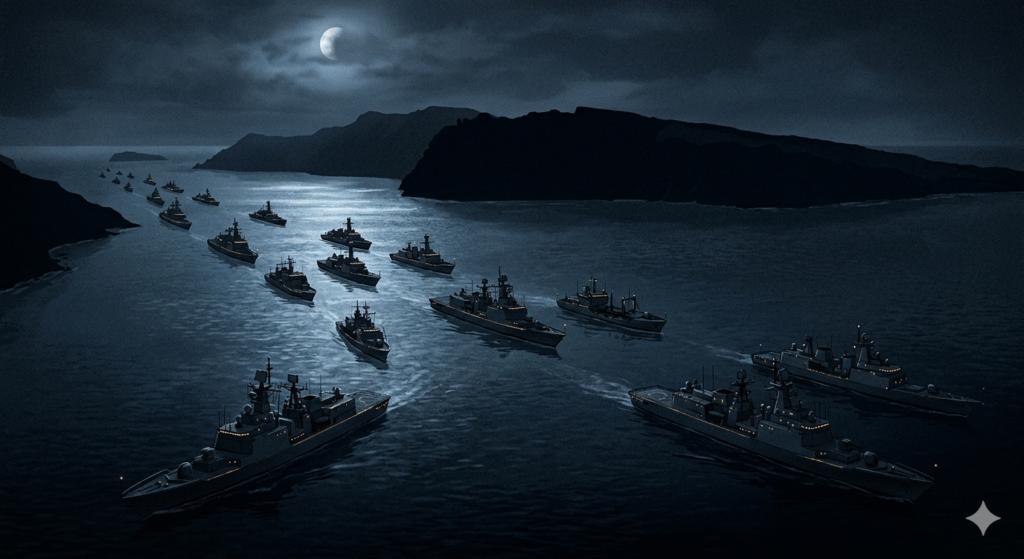
The most important historical parallel is the 1950 Korean War. That conflict began with a perceived window of US distraction and military weakness. It drew in China, killed millions, and remains technically unresolved 70+ years later. Analysts warn that a Taiwan conflict could similarly calcify into a permanent unresolved state — with even greater global economic consequences given Taiwan’s role in the semiconductor supply chain.
The 1982 Falklands War offers a different lesson: a militarily weaker party (Argentina) attempted to seize territory from a major power (UK) and was decisively repelled at significant cost. Some analysts argue this is the closest analogy to a failed Chinese amphibious assault — costly, embarrassing, and politically destabilizing for the aggressor.
What a Taiwan Conflict Would Cost the World
A Taiwan Strait military conflict would not be a regional event. The economic consequences would be felt in every country on Earth within weeks. Here is what expert institutions project the costs would be.
The TSMC Problem
TSMC — Taiwan Semiconductor Manufacturing Company — is arguably the single most strategically important private company in the world. It manufactures chips that go into every iPhone, nearly every modern car, every AI data centre, and every advanced weapons system that the US, Europe, Japan, and Taiwan’s own defence systems depend on. In 2025, TSMC’s 3nm and 2nm chips were years ahead of any facility anywhere else on Earth.
A RAND Corporation study estimated that even a partial disruption to TSMC production lasting six months would trigger a global recession comparable to the 2008 financial crisis. A complete shutdown — whether through physical destruction, a naval blockade, or Beijing seizing the facilities — could set back global technology capability by 3–5 years. New chip facilities being built in the US, Germany, and Japan will not reach full capacity until 2027–2028 at the earliest.
South China Sea Trade Routes
Approximately $5.5 trillion in global trade passes through the South China Sea annually — roughly a third of all maritime trade worldwide. A conflict that closes or disrupts these shipping lanes would spike energy prices, food prices, and consumer goods prices globally within weeks. The countries most exposed — Japan, South Korea, Vietnam, the Philippines, Australia — would face immediate import crises.
✓ Expert-Recommended Resources
Preparing for Global Supply Chain Disruption
Any major-power conflict — whether in the Taiwan Strait, the Middle East, or elsewhere — disrupts global supply chains, energy prices, and food systems. FEMA, the Red Cross, and emergency management professionals recommend the following preparations regardless of where you live. Search volume for “emergency food supply” has surged over 650% this week.
Frequently Asked Questions: China–Taiwan Conflict 2026
Will China invade Taiwan in 2026?
As of April 2026, no invasion has occurred. Most military analysts, including those at RAND and CSIS, assess a large-scale military invasion as unlikely in 2026 but acknowledge that the risk level is the highest it has been since 1996. The most likely near-term scenario remains continued grey-zone pressure — ADIZ incursions, economic coercion, and information operations — rather than full-scale military action. The factors that make an invasion unlikely include: enormous military costs to China even in a successful scenario, catastrophic economic self-harm from disrupting global trade, and China’s preference for coercive pressure over kinetic warfare where possible.
How many people would die in a China–Taiwan war?
The CSIS 2023 war game — the most detailed unclassified study of a Taiwan conflict ever conducted — projects approximately 17,000+ military deaths in a 3-week scenario: 3,200+ US personnel, 3,500+ Taiwanese military, and 10,000+ PLA soldiers. Civilian casualties in Taiwan are projected at 50,000–200,000 in the baseline scenario, depending on the extent of urban warfare. A prolonged conflict of Korea-War length could produce millions of casualties. All figures in this article are projections, not confirmed deaths from an active conflict.
What would a China–Taiwan war mean for the global economy?
The Munich Security Conference estimated a Taiwan conflict would cost over $2 trillion in global GDP in the first year. The primary driver is TSMC, which produces approximately 90% of the world’s most advanced chips — used in everything from iPhones to weapons systems to cars. The South China Sea carries $5.5 trillion in annual trade, and disruption would spike energy and food prices globally within weeks. Unlike past economic crises, there is no monetary policy fix for a physical supply chain collapse of this scale.
Why does China want Taiwan?
China’s claim to Taiwan stems from the 1949 Chinese Civil War, when the defeated Nationalist government retreated to Taiwan. The PRC has never governed Taiwan, but considers it a province pending “reunification.” Beyond history, Taiwan has enormous strategic value: it sits astride critical shipping lanes, hosts the world’s most advanced chip manufacturing, and represents a democratic Chinese-speaking society that implicitly challenges the CCP’s narrative that Chinese governance requires authoritarianism. For Xi Jinping personally, completing “national rejuvenation” by resolving the Taiwan question is a stated core goal of his political legacy.
Would the United States actually defend Taiwan?
The US maintains deliberate “strategic ambiguity” — it neither confirms nor denies a military response. The Taiwan Relations Act (1979) requires the US to provide defensive weapons and maintain the capacity to resist coercion. Multiple presidents, including Biden, have verbally committed to defending Taiwan. The CSIS war game assumes US intervention — and still projects 3,200+ US military deaths and major naval losses. The ambiguity is strategic: too explicit a commitment removes US diplomatic flexibility; too weak a signal invites Chinese miscalculation.
Could a Taiwan war go nuclear?
Analysts assess nuclear escalation as low probability but not zero. Both the US and China have nuclear arsenals and mutual assured destruction deterrence. However, RAND analysts identify what they call the “termination problem” — once conventional war begins between nuclear powers, both sides face enormous pressure to escalate rather than accept defeat. China’s “No First Use” policy is official doctrine but its reliability under battlefield stress is debated. Most scenarios consider nuclear escalation a catastrophic failure of deterrence rather than a planned option for either side.
How This Data Was Compiled

What the Data Actually Tells Us
The Taiwan question is not a hypothetical history lesson. It is the most consequential unresolved geopolitical question of our era — one that involves two nuclear-armed superpowers, the world’s most important technology supply chain, and a functioning democracy of 23 million people.
What the data from CSIS, RAND, and the Pentagon tells us is this: a military conflict in the Taiwan Strait would be catastrophic for everyone involved — including China. There are no clean outcomes. The CSIS war game found that China fails in most invasion scenarios, but at the cost of a shattered global economy, hundreds of thousands of deaths, and a significantly degraded US military force.
The most rational path — one that most Chinese strategic thinkers acknowledge privately — is continued economic and political pressure rather than outright military action. The question of 2026 is not whether China will invade tomorrow. The question is whether the accumulation of military buildup, the reduction in US focus due to other theatres, and the domestic political pressures on Xi Jinping create the conditions for a miscalculation — the kind of accidental escalation that has started many of history’s most costly wars.
We will update this article as the situation develops. Verified data only.
Share This Research
Help spread verified data — not misinformation